Guide16 min read
Understanding Rat Body Language: A Visual Guide to What Your Rats Are Telling You
Last checked: 7 November 2026.
Related pieces
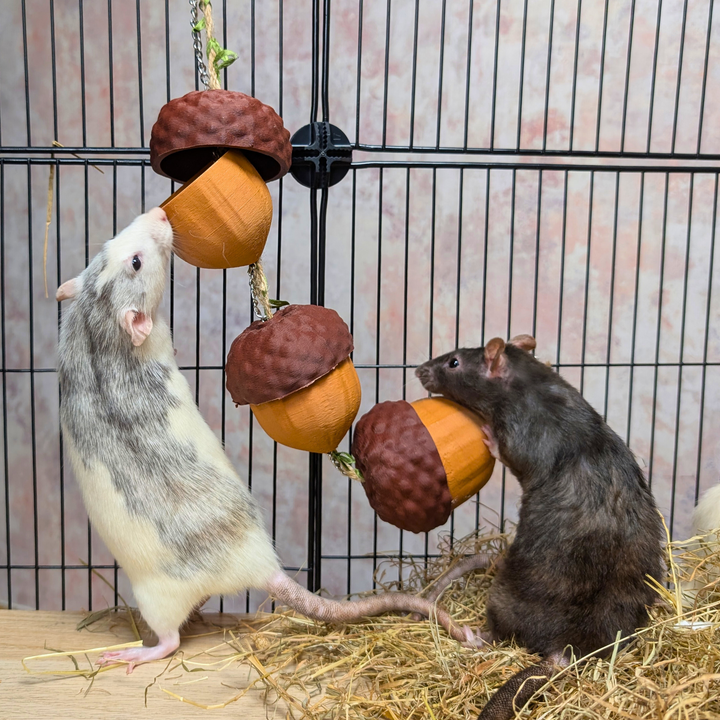
Acorn Rat Foraging Garland – 3 Cups
Now £31.19
Was £38.99
Quick read: This guide introduces common rat postures, sounds, smells and touch signals to observe in context.
Short answer: Read rat body language as a whole picture, not a single signal. Relaxed bruxing and boggling often accompany contentment, while a tense body, raised fur or withdrawal can suggest stress or illness. Watch what is normal for each rat and seek an exotics vet’s advice about changes in breathing, appetite, movement or social contact.
Rat body language chart
This is an observation chart, not a way to diagnose pain or read a rat’s mind. A short video and notes on eating, breathing and when the behaviour started are more useful to your vet than a label such as “sad” or “dominant”. Never put bare hands between fighting rats.
| Signal | What you see or hear | What it usually means | What to do | Source |
|---|---|---|---|---|
| Bruxing | Soft tooth grinding | Often contentment; can also accompany distress | Read posture, appetite and setting together. | NZ Fancy Rat Society |
| Boggling | Eyes move in and out with grinding | Often pleasure; not proof of good health | Check for other signs of discomfort. | NZ Fancy Rat Society |
| Popcorning | Quick playful hops | May be excited play, not a diagnosis | Watch for normal movement and willing return to play. | NZ Fancy Rat Society: young-rat play |
| Piloerection | Fur raised | Arousal, stress or illness may be involved | Give space; vet advice if persistent or with illness signs. | Greatfield rescue; RSPCA health |
| Sidling | Sideways approach with arched back | Threatening behaviour rather than ordinary play | Prevent escalation safely; seek experienced advice. | NZ Fancy Rat Society |
| Tail flick or lash | Sharp side-to-side movement | Can accompany irritation or tension | Stop handling and allow a retreat. | Greatfield rescue |
| Ear colour | Ears look pinker or paler | Not a reliable stand-alone mood test | Read overall condition; ask a vet about a sudden concerning change. | RSPCA health: whole-rat checks |
| Ear wiggling | Rapid ear vibrations in a female | Can accompany being in heat | Allow space; do not confuse every movement with illness. | NZ Fancy Rat Society |
| Power grooming | One rat holds and grooms another | Social interaction; may become one-sided | Watch whether both can disengage; seek help for bullying. | Greatfield rescue |
| Porphyrin staining | Red-brown marks near nose or eyes | May accompany stress or a health problem | Vet advice for recurring, heavy staining or other changes. | RSPCA health |
| Hunching | Tight, rounded posture | Possible discomfort or illness | Contact an exotics vet, especially if eating or activity changes. | Greatfield rescue; RSPCA health |
| Chattering with tension | Grinding with alert or defensive posture | Not safely labelled happy bruxing | Give space and check for pain or illness. | NZ Fancy Rat Society |
| Boxing | Upright rats paw at each other | Brief play or defensive conflict | Look for breaks and other tension, not just the pose. | NZ Fancy Rat Society |
| Pinning | One rat holds another down | Can occur during social play or conflict | Intervene safely if distress, injuries or persistent targeting occur. | Greatfield rescue |
| Licking hands | Tongue contact with your skin | May be exploratory or social | Allow choice; do not treat it as proof of affection. | Greatfield rescue: voluntary contact |
| Nibbling hands | Gentle mouth contact | Context matters; not a dependable mood label | Keep hands still, let the rat move away; assess painful biting. | Greatfield rescue: approach and handling |
| Sniffing and moving whiskers | Nose and whiskers investigate | Often exploration | Let the rat investigate without forcing handling. | Greatfield rescue |
| Freezing or flattening | Rat becomes still and low | May be fear or discomfort | Reduce disturbance and offer a hiding place. | Greatfield rescue |
| Repeated hiding | Stays away more than usual | Stress or illness, not simply shyness | Check the environment and consult a vet about a change. | Greatfield rescue; RSPCA health |
| Squeaking | Audible squeak during contact | Protest, discomfort or a social interaction | Watch the context; investigate repeated distress. | NZ Fancy Rat Society |
| Chasing with pauses | Rats pursue and wrestle, then stop | Often play when reciprocal and relaxed | Observe the quieter rat as well as the pursuer. | NZ Fancy Rat Society; Greatfield rescue |
| Over-grooming | Repeated grooming or bald areas | May reflect stress or skin problems | Ask a vet; do not assume boredom alone. | RSPCA health |
| Head swaying | Side-to-side scanning | Can help a pink-eyed rat compensate for poor vision | Ask a vet about new imbalance or a change from normal. | NZ Fancy Rat Society; RSPCA health |
| Food stashing | Moves food into hiding places | Common individual habit | Remove perishable leftovers; monitor actual intake. | NZ Fancy Rat Society |
| Reduced grooming | Unkempt coat | Possible illness or difficulty caring for itself | Contact a vet rather than treating it as a personality trait. | RSPCA health |
Use this on your site
You're welcome to copy this chart into your own care sheet, forum post, school project or club page. Please credit it with a link:
Source: Bruxlings (checked November 2026)
Source: <a href="https://ripleysnest.co.uk/pages/rat-body-language-visual-guide#rat-body-language-chart">Bruxlings</a> (checked November 2026)
More free charts: free-to-use charts and tables.
Rats communicate constantly, through posture, sound, smell, and touch. Learning their language is the single fastest way to deepen your bond.
Quick Summary
Rat body language is a complete communication system that most owners learn to read intuitively over time, but understanding the key signals accelerates the bonding process and helps identify stress or illness earlier. Bruxing and boggling often accompany contentment, but can also occur with distress. Raised fur, hunching and tail movement need context rather than a single fixed translation. This visual guide covers the most common signals and what they mean in context.
Quick summary: Rats communicate constantly through body postures, sounds, and subtle physical changes. Learning to read these signals helps you spot happiness, fear, illness, and social tension early. This guide covers every common behaviour, what it means, and when you should step in.
In this guide:
- Bruxing and boggling: the sound of a happy rat
- Piloerection: when fur stands on end
- Sidling: the sideways shuffle
- Power grooming vs aggressive grooming
- Belly-up: trust or submission?
- Ear positions and what they mean
- Tail wagging: not what you think
- Chattering and hissing: back off signals
- When to worry: red flags
- Behaviour quick-reference table
Key TipBruxing (tooth grinding) combined with boggling (eyes vibrating rapidly in sockets) often accompanies contentment, but can also occur with discomfort. Read posture, appetite and health together rather than treating this as proof of complete trust.
Bruxing and boggling: the sound of a happy rat
Bruxing (tooth grinding) combined with boggling (eyes vibrating rapidly in sockets) often accompanies contentment, but can also occur with discomfort. Read posture, appetite and health together rather than treating this as proof of complete trust.
Bruxing (teeth grinding) and boggling (eyes bulging in and out) are signs of contentment in most contexts. Think of it as the rat equivalent of purring.
Rats grind their incisors together rhythmically. This is bruxing, and it is usually a sign of deep relaxation. You will hear it when your rat is curled up on your lap, being gently stroked, or settling down for sleep. The sound is a soft, repetitive clicking or chattering.
Boggling is what happens when bruxing gets intense. The jaw muscles that control grinding sit directly behind the eye sockets. When a rat bruxes hard enough, the contracting muscles push the eyes in and out rhythmically. It looks alarming the first time you see it. It is not.
Context matters. Bruxing can occasionally signal stress rather than happiness. A rat at the vet may brux as a self-soothing mechanism, the same way a person might hum when anxious. Read the rest of the body: if the rat is relaxed, loose-bodied, and in a familiar environment, bruxing is contentment. If the body is tense or hunched, bruxing may be a coping response.
Tip: New rat owners often panic the first time they see boggling. Bookmark this section. You will need it within the first week.
Piloerection: when fur stands on end
Puffed-up fur (piloerection) can mean fear, aggression, cold, or illness. You need to read the full picture.
Piloerection is the involuntary raising of fur along the body. In rats, it is controlled by the sympathetic nervous system, the same fight-or-flight response found in all mammals. The fur stands up to make the animal look larger.
What causes it:
| Trigger | Additional Signs | Action |
|---|---|---|
| Fear or anxiety | Frozen posture, wide eyes, ears back, may be hiding | Remove the stressor. Give space |
| Aggression | Sidling, arched back, hissing, teeth chattering | Separate rats if directed at a cagemate |
| Cold | Curled up, tucked paws, seeking warmth | Check room temperature (18-22C is ideal) |
| Illness | Lethargy, hunched posture, reduced eating | Vet visit. Piloerection combined with hunching is a red flag |
A rat that is puffed up and moving aggressively toward another rat is escalating. A rat that is puffed up and hiding is scared. A rat that is puffed up and lethargic is possibly unwell. Same physical response, three very different meanings. Always read the context.
Sidling: the sideways shuffle
Sidling is a dominance display. The rat moves sideways toward another rat with fur raised and body arched, making itself look as large as possible.
When a rat approaches another sideways, with its body arched and fur standing on end, it is sidling. This is a deliberate dominance display. The rat is saying "I am bigger and stronger than you."
Sidling is common during introductions, after cage changes, and when a group's hierarchy is unsettled. It is part of normal social negotiation and does not automatically require intervention.
When to watch closely: If sidling escalates to lunging, biting that draws blood, or ball-fighting (two rats rolling together in a tight ball), you need to separate and reassess your introduction process. Sidling on its own, even with some chasing, is normal dominance behaviour.
When to relax: If the other rat responds by flattening, looking away, or offering grooming, the hierarchy is settling naturally. This is healthy communication.
Tip: Sidling is most common in intact (unneutered) males. Neutering significantly reduces dominance-related aggression in male rats, though it does not eliminate it entirely.
Power grooming vs aggressive grooming
Power grooming is a dominance behaviour where one rat holds another down and grooms forcefully. It is normal unless it causes wounds or chronic stress.
Rats groom each other constantly. It is a social bonding behaviour and a way to maintain fur quality in hard-to-reach areas. Mutual grooming between calm, relaxed rats is one of the strongest signs of a bonded group.
Power grooming looks different. One rat pins another (usually belly-up or face-down) and grooms vigorously, often around the face and behind the ears. The groomed rat may squeak or wriggle but generally accepts it. This is the dominant rat reinforcing its position. It is normal and healthy.
When it crosses a line:
- The groomed rat has bald patches or scabbing behind the ears or on the neck
- The groomed rat is chronically stressed (weight loss, hiding, reluctance to eat with the group)
- The grooming rat does not stop when the other squeaks loudly or tries to escape
- Grooming sessions are always one-directional (one rat never reciprocates)
If you see bald patches or wounds, you have moved past power grooming into barbering or over-grooming, which may need environmental changes (more space, more enrichment) or veterinary advice.
Belly-up: trust or submission?
A rat lying belly-up while being groomed by a cagemate is showing submission. A rat flopping belly-up on your hand is showing trust. The context tells you which.
Belly-up is one of the most misread rat behaviours because it means two different things depending on the situation.
With other rats: Lying belly-up is a submission signal. The rat is exposing its most vulnerable area to say "you win, I am not a threat." During introductions or after a scuffle, the subordinate rat will often flip onto its back. This is exactly the response you want. It means the hierarchy is being accepted without a fight.
With humans: A rat that flops onto its back in your hand, or rolls over while being tickled, is showing trust. Rats only expose their belly to humans they feel completely safe with. This behaviour takes time to develop. If your rats are doing this within the first few weeks, you are doing something right.
The key difference: Look at the body tension. A submitting rat is tense and still. A trusting rat is loose and relaxed. A submitting rat freezes in position. A trusting rat melts into it.
Ear positions and what they mean
Ears forward and perked means curious or alert. Ears flattened back means scared, stressed, or unwell. Ears relaxed to the sides means calm.
Rat ears are surprisingly expressive once you know what to look for.
| Ear Position | Meaning | Context |
|---|---|---|
| Forward and erect | Curiosity, alertness, interest | Hearing a new sound, exploring, food nearby |
| Relaxed, slightly to the sides | Calm, content | Resting, being handled gently, post-play |
| Flat against the head | Fear, stress, pain, or illness | New environment, vet visit, post-surgery, respiratory distress |
| One forward, one back | Uncertain, assessing | Encountering something new, deciding whether to approach |
Ear position alone is not diagnostic. Combine it with body posture and behaviour. A rat with flat ears and a hunched body needs attention. A rat with flat ears during a nap is just sleeping deeply.
Tip: Rex (curly-coated) rats sometimes have naturally crinkled ears that sit differently to standard ears. Learn your individual rat's baseline before interpreting ear position.
Tail wagging: not what you think
Rats wag their tails when agitated or stressed. This is not happiness. It is the opposite of a dog's tail wag.
This trips up nearly every new rat owner. A rat swishing or flicking its tail side to side is not happy. Tail wagging in rats signals agitation, frustration, or stress. You may see it during introductions, at the vet, or when a rat is cornered or overstimulated.
Tail swishing during introductions is a warning sign. It means the rat is stressed and may escalate to aggression. If you see tail wagging combined with piloerection and sidling, slow the introduction down.
Tail standing erect (tail flagging) is a related behaviour, most common in females in heat. The tail rises stiffly while the rat arches her back and moves her ears rapidly (known as "ear wiggling"). This is hormonal, not distress.
A relaxed rat's tail trails behind it loosely or curls gently. If you see rhythmic side-to-side movement, pay attention to what is causing the agitation.
Related pieces
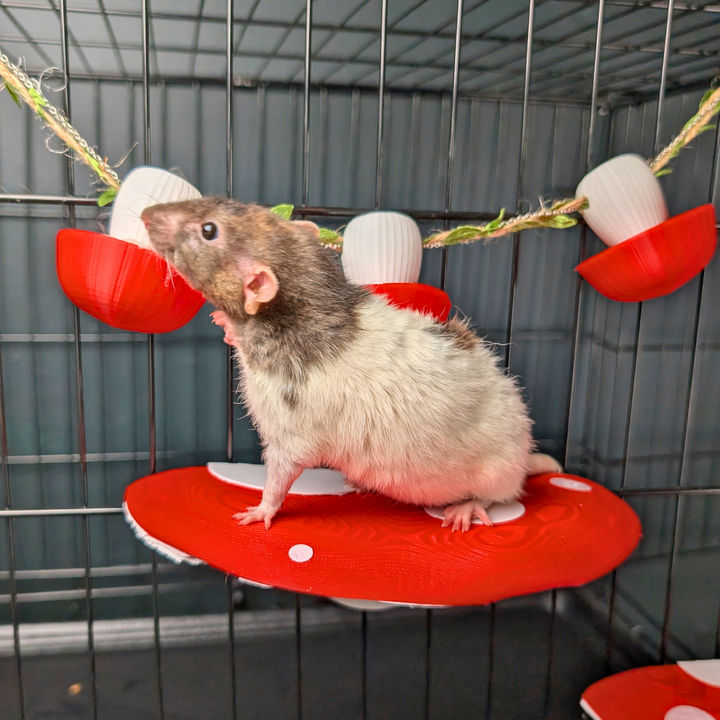
Mushroom Rat Foraging Cups – Pair
Now £23.19
Was £28.99
Chattering and hissing: back off signals
Teeth chattering (distinct from bruxing) and hissing are clear warning signals. The rat is saying "back off" and may bite if pushed.
Teeth chattering sounds similar to bruxing but is louder, sharper, and more staccato. The difference is context and volume. Bruxing is quiet and rhythmic during relaxation. Chattering is loud and rapid during confrontation.
Hissing is exactly what it sounds like. Rats hiss when they feel cornered, threatened, or pushed past their tolerance. A hissing rat is a rat that may bite next.
What to do:
- Do not reach for a chattering or hissing rat. Give it space
- If directed at a cagemate, watch for escalation but do not intervene immediately (chattering often resolves without contact)
- If directed at you, assess why. Were you reaching into a nest? Waking them suddenly? Handling a rat in pain?
- Persistent chattering or hissing toward cagemates that were previously bonded can signal pain or illness. A sudden personality change warrants a vet check
When to worry: red flags
Single behaviours rarely mean trouble on their own. Combinations and sudden changes are what matter.
See a vet if you notice:
- Piloerection + hunched posture + reduced eating (possible respiratory infection or pain)
- Sudden aggression in a previously calm rat (pain, hormonal changes, neurological issue)
- Chattering directed at bonded cagemates with no obvious trigger (pain response)
- Complete social withdrawal (hiding, refusing to come out for food or free roam)
- Repeated head tilt or circling (inner ear infection or pituitary tumour)
Behaviours to read in context:
- Boggling often accompanies contentment; unusual movements or other illness signs need a vet
- Red staining near eyes or nose: recurring or heavy staining warrants a vet check
- Occasional squeaking during play can be communication; investigate persistent distress
- Sleeping in a pile so tangled you cannot tell whose tail is whose
- Bruxing and boggling when held
- Grooming you or cage mates
- Bouncy, loose gait during play
- Running to greet you at cage door
- Pinning cage mates playfully (then swapping)
- Puffed fur with hunched posture
- Repeated scratching at one spot
- Tail-rattling (extreme agitation)
- Sudden aggression with no context
- 22kHz vocalisations (audible clicking/chirping)
Behaviour quick-reference table
| Behaviour | Likely Meaning | Worry Level |
|---|---|---|
| Bruxing (quiet teeth grinding) | Happy, relaxed | None |
| Boggling (eyes pulsing) | Very happy | None |
| Piloerection (puffed fur) | Fear, aggression, cold, or illness | Check context |
| Sidling (sideways approach) | Dominance display | Watch for escalation |
| Power grooming | Dominance, normal | Check for wounds |
| Belly-up (with rats) | Submission | Healthy sign |
| Belly-up (with you) | Trust | Excellent sign |
| Ears forward | Curious, alert | None |
| Ears flat | Scared, stressed, or unwell | Check context |
| Tail wagging | Agitation, stress | Pay attention |
| Tail flagging (erect) | Female in heat | Normal |
| Teeth chattering (loud) | Warning, back off | Do not push |
| Hissing | Serious warning | Give space immediately |
Where to go from here
Understanding body language is the foundation for everything else: introductions, health monitoring, and enrichment. If you can read your rats, you can respond to what they need before small problems become big ones.
Related guides:
- How to introduce new rats (carrier method)
- Rat health monitoring: what to check weekly
- Enrichment ideas for pet rats
Sources
Veterinary and welfare guidance
Professional Organisations
- RSPCA. "Rat behaviour." rspca.org.uk
- National Fancy Rat Society (NFRS). "Behaviour and body language." nfrs.org
- Blue Cross. "How to care for your rat." bluecross.org.uk
- Universities Federation for Animal Welfare. "Rat welfare guidelines."
Veterinary Behaviour Resources
- Isenbugel, E. & Ruedi, D. "Small mammals: health, husbandry and diseases." In Manual of Exotic Pets, BSAVA, 1993.
Community Resources
- Rat Guide (ratguide.com). "Behavioural glossary."
- Rat Report. "Understanding rat body language."
- Shadow Rat Project. "Rat behaviour and communication."
Further Reading
This general pet-care guide is not a substitute for professional veterinary advice. Speak to a rat-experienced vet about health concerns and individual care decisions. Care references are listed above.
Further reading: RSPCA rat behaviour | National Fancy Rat Society | Blue Cross rat advice
Hear from us now and then
New pieces from the studio and the odd tip for your rats, about once a fortnight. You can leave any time.
Shop this guide
All rat cage accessories


Frequently asked questions
Shop and keep reading
Shop the range: the rat care range and foraging puzzles.
Read next: rat body language basics and when a rat is on its own.
Questions rat owners ask
My rat grooms me, what does that mean?
Gentle grooming can be a social interaction. Allow your rat to choose contact and read the rest of its behaviour rather than treating grooming as proof of a particular feeling.
Why does my rat thump the floor?
A movement or noise alone does not have a certain translation. Check what happened before it, the rat’s posture and whether it is moving normally. Ask a vet about new or repeated unusual movements.
What does it mean when my rat chatters their teeth?
Tooth grinding can accompany contentment, stress or discomfort. Sound alone cannot distinguish them: check posture, appetite and other changes, and seek vet advice when concerned.
Does bruxing mean a rat is happy?
Bruxing, the soft teeth-grinding sound, is usually seen when a rat is content. Read it with the rest of the body: relaxed posture, a calm approach and normal eating. Use the red flags section above for changes that need a vet.
What does it mean when a rat stands its fur on end?
Raised fur, or piloerection, can happen in several situations. Look at the whole picture in the guide, and check with a vet if it comes with changes in breathing, eating or energy.
How do rats communicate?
Rats communicate through posture, movement, sounds, scent and touch. Watch the whole interaction and each rat’s normal behaviour rather than translating one gesture in isolation.
What do rat sleeping positions mean?
A sleeping position alone cannot tell you a rat’s mood or health. Compare normal waking activity, breathing, appetite and social behaviour, and contact a vet about concerning changes.
Does a rat’s ear colour show happiness?
Do not use ear colour as a happiness test at home. Read the whole rat and its setting; sudden changes with illness signs need veterinary advice.