Guide13 min read
Rat Toys: The Best Enrichment Toys That Actually Keep Rats Busy
Quick read: The best rat enrichment toys are chosen by cage job: foraging for busier feeding, hides for calmer sleeping spaces, shelves and ropes for climbing paths, and simple paper or cardboard for shredding. Start with the missing behaviour, then choose the piece.
Which rat enrichment toy should you buy first?
When choosing toys for rats, start with the behaviour you want to encourage. Rat foraging toys make feeding last longer. Open hides give nervous rats calmer sleeping spots. Ledges and ropes add movement. Shredding materials keep busy rats occupied without making the setup complicated.
| What your rats need | Start with | Helpful next step |
|---|---|---|
| More food searching | Foraging toys | PDSA suggests scattering rats’ nuggets around the cage to encourage searching; you can start with part of their usual meal at no extra cost. For fixed feeding points, compare the cups and garland below. |
| More calm resting space | Open hides and cabins | Use more than one sleeping spot so no rat has to guard the best one. |
| More climbing and movement | Ledges, shelves and climbing pieces | Build a path across the cage with safe landings and no long drops. |
| A fuller cage from scratch | Fairy mushroom cage kit | Use the kit as the main structure, then rotate smaller enrichment around it. |
For a wider setup plan, read the rat cage enrichment ideas guide or the rat cage accessories UK guide.
The best rat enrichment toys in the UK are the ones that make your rats forage, climb, hide, shred, solve, balance, and choose what to do next. A good cage is not a showroom. It is a busy cage setup where a mischief can investigate, sleep, stash food, rearrange bedding, and cause mild chaos with purpose.
That is why generic "best toy" lists are usually thin. They name hammocks, chew sticks, ropes, and cardboard tubes, then leave you to guess what actually belongs in your cage. The better question is not "which toy should I buy?" It is "which behaviour am I trying to give them?"
For UK owners, that means balancing welfare guidance, cage size, cleaning, budget, and personality. A lazy buck, a frantic youngster, a shredder, a climber, and a nervous rescue will not use the same setup in the same way.
Plan the space around the toys with our rat cage setup guide.
The real flex is not a cage packed with expensive bits. It is a cage where every item has a job.
Start With Behaviours, Not Products
Rats need enrichment because they are active, curious, social animals. The RSPCA rat environment guidance says rats need space to run, stretch, climb, explore, hide, and investigate, with complex enrichment such as tunnels, ropes, hammocks, paper tissues, ladders, and shelters. The PDSA rat care guide similarly describes a cage with multiple levels, nesting areas, toys, ropes, ladders, branches, and shelves.
That gives us a much better shopping framework. Every cage should cover five enrichment jobs: social, physical, foraging, cognitive, and sensory. Social companionship and cage enrichment are complementary: PDSA says rats need a rat companion (or two), while enrichment gives them separate opportunities to explore, forage, and climb. Physical enrichment means climbing, balancing, stretching, digging, and moving at different heights. Foraging enrichment means making food take effort. Cognitive enrichment means puzzles, training, scent games, and novelty. Sensory enrichment means bedding, nesting, texture, scent, and digging options.
Buy by behaviour. Before adding another item, ask whether it adds foraging, climbing, hiding, chewing, nesting, digging, or problem-solving. If it does none of those, it is probably cage clutter.
This is where experienced owners differ from beginners. Beginners often buy a matching set. Experienced owners build a system: a deep base or dig area, multiple hides, fall breakers, ropes, ledges, shreddables, washable resting spots, and a few food puzzles that get changed before the rats get bored.
If you are planning the whole cage rather than one toy, keep the Rat Cage Accessories UK guide open beside this page. Use this guide for enrichment behaviour, then use the accessories guide to check hides, ledges, foraging pieces, cleaning access, and cage layout together.
The 7 Best Rat Enrichment Toy Types
If you are buying rat enrichment toys in the UK, these are the categories worth prioritising before novelty extras.
| Type | Best for | What to look for |
|---|---|---|
| Foraging cups and puzzle feeders | Busy feeding time | Easy to refill, easy to clean, not too frustrating |
| Hides and houses | Resting, confidence, cage zones | Dark, roomy, stable, multiple options in the cage |
| Shelves and perches | Climbing and choice-building | Good spacing, stable fixing, fall breakers beneath |
| Ropes, ladders, and bridges | Balance and movement | Thick enough to grip, placed away from long drops |
| Dig boxes | Natural digging and scent work | Appropriate substrate, shallow start, supervised introduction |
| Shredding and nesting materials | Busy paws and bedding choice | Paper-based materials and simple cardboard |
| Training and free-roam puzzles | Brain work outside the cage | Short sessions, food motivation, low pressure |
Foraging toys are often the best first upgrade because they change daily routine immediately. Instead of food appearing in one bowl, dry mix can be scattered, tucked into paper, hidden in cups, or placed around the cage. That gives rats a reason to move and investigate.

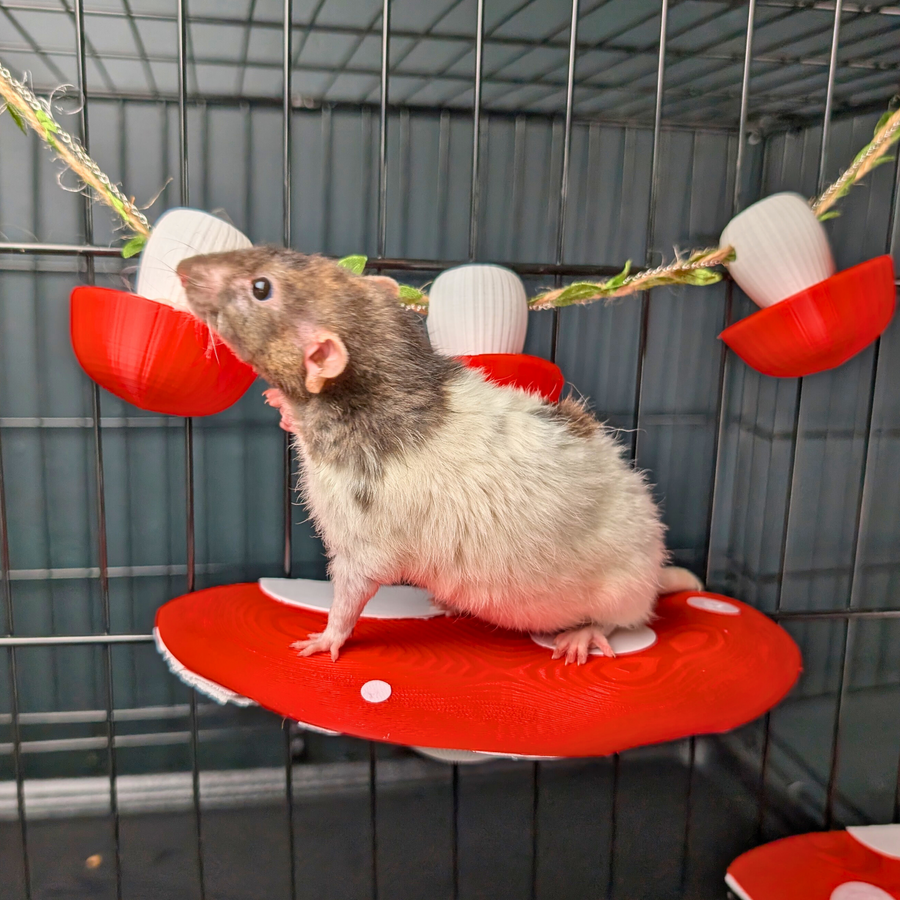
Choose your foraging format. The Mushroom Foraging Cups are a pair of compact cups, each about 7 cm high, that clip to the bars together or at different heights. The Acorn Foraging Garland spreads three cups along a hanging ivy garland about 40 to 60 cm long, so food is found in three places. Use small amounts of dry food or treats in either, hang them clear of doors and ramps, and check the fittings when you clean.
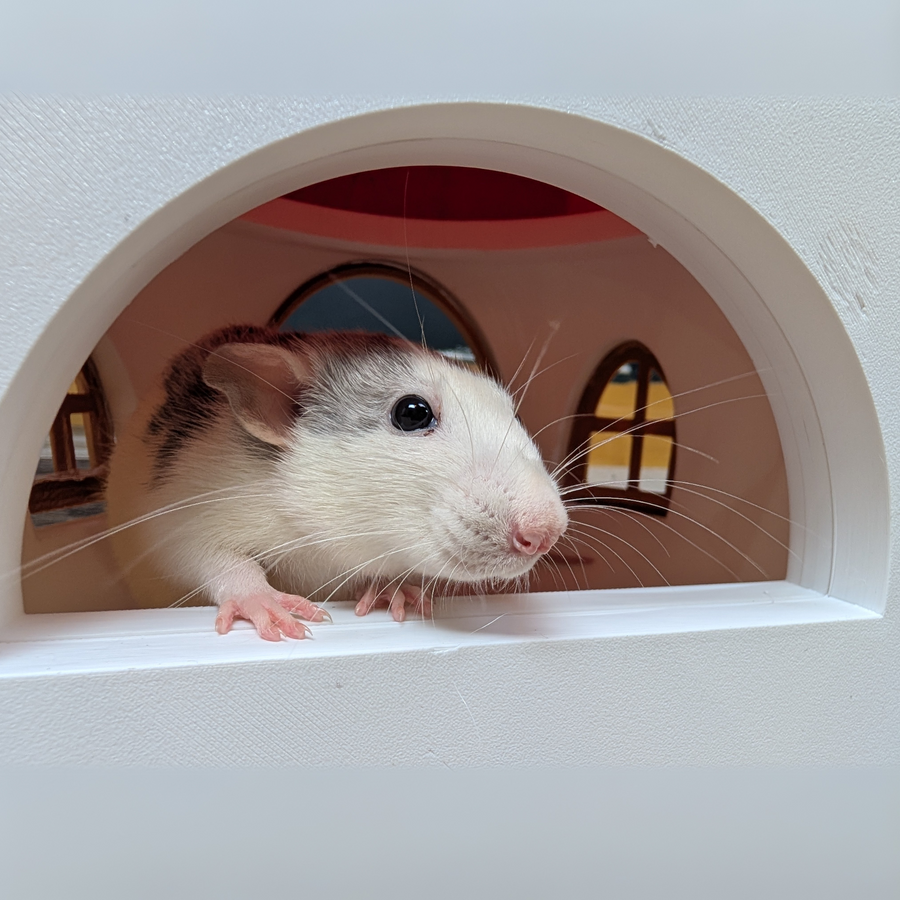
Hides matter just as much. The RSPCA says rats need hiding places where they can escape if afraid, nest, rest, and get out of bright light. In practice, one hide is not enough for a group. Give them options: a low hide, a high hide, a soft sleeping area, and a darker retreat.
Do not fill every gap with decor. Rats need complexity, but they still need movement, ventilation, cleaning access, and places to move without squeezing through awkward spaces.
What Experienced UK Rat Owners Actually Buy
Most quick shopping lists point to hammocks, ropes, chews, cardboard tubes, snuffle mats, and DIY boxes. That is not wrong, but it is not enough. It names things to buy without helping you decide what your rats actually need next.
Experienced owners usually think in cage zones. One area is for sleeping, one is for feeding or foraging, one is for climbing, one is for digging, and one is a messy bit where the rats can shred things without ruining the whole setup. They also talk about "fall breakers", "rotation", "deep bases", "scatter feeding", and "the girls" or "the boys" as a mischief with individual habits.
- Foraging cups and refillable feeders
- Stable shelves and ledges
- Dark hides in more than one cage zone
- Washable hammocks and resting spots
- Ropes, bridges, and fall breakers
- Simple cardboard and paper shredding options
- One-off toys that cannot be cleaned
- Tiny hamster items sold as rat accessories
- Pretty pieces with no behaviour purpose
- Anything that creates a long unbroken fall
- Items with awkward gaps, loose strands, or poor fixings
For Ripleys Nest, the strongest enrichment matches are pieces that combine cage function with personality: the Mushroom Rat Foraging Toy Cups, the Dragon Rat Shelf Set, the Fairy Mushroom Rat Cage Accessory Kit, and the wider rat accessories collection. They are not a replacement for free-roam time, social housing, or cleaning. They are part of the cage system.

Best Rat Toys by Personality
The mistake is buying for the cage photo instead of the rats in front of you. A beautiful setup is pointless if the mischief ignores half of it.
For a lazy rat, start with low-effort foraging. Hide a small portion of dry mix in cups, folded paper, or shallow puzzle spaces. Keep the first wins easy. Once they understand the game, make it harder by spreading food across levels.
For a climber, prioritise shelves, ropes, bridges, hammocks, and fall breakers. Climbing enrichment should never mean risky height for the sake of it. Think paths, not cliffs. A high shelf should have another choice down and something beneath it to soften a stumble.
Map the cage like a climbing wall. If a rat slips from any point, ask what breaks the fall. Hammocks, large shelves, and staggered platforms are not just cute. They are cage planning.
For a nervous rat, add hides before adding challenge. A confident rat will explore a new toy. A nervous rat may need a retreat first, then a low-pressure reason to leave it. Put a foraging cup near the hide entrance before expecting full-cage exploration.
For shredders, give legal targets: cardboard, paper, simple nesting materials, and refillable items where destruction is part of the job. If they are going to redecorate anyway, give them the cheap stuff and save the better pieces for structure.

Budget: Under 5, 15, and 30 Pounds
You do not need a huge budget to enrich a rat cage. In fact, some of the most useful setups are not expensive hauls. They are clever setups using cardboard, fleece offcuts, ropes, baskets, and rotated feeding games.
Under 5 pounds, focus on cardboard tubes, egg boxes, paper bags, tissue for nesting, and a shallow pea-fishing dish for supervised warm-weather fun. These are not glamorous, but rats do not care about glamour. They care about whether something can be sniffed, moved, shredded, climbed through, or raided for food.
Starter DIY idea: wrap a pinch of their usual dry food in plain paper, push it into a cardboard tube and fold the ends in. PDSA suggests hiding food in paper bags, tubes and boxes to encourage searching. Use plain, unprinted card, watch the first go, and bin it once it is damp or soiled.
Under 15 pounds, add one better reusable item: a foraging feeder, a hammock, a rope, a shelf, or a small hide. This is where you start building a rotation box so every clean-out does not look identical.
At 30 pounds and up, buy structure. Multi-piece sets, themed hides, shelf groups, and cage bundles give you more control over paths and zones. That is also where handmade and hand-finished pieces make sense, because they add character while still doing a proper cage job.
Do not assume every small animal toy suits rats. Rats are stronger, cleverer, and more destructive than many products expect. Check size, fixings, strands, sharp edges, cleanability, and whether the item suits a group.
How to Rotate Rat Enrichment Without Stressing Them
Rotation is the difference between enrichment and furniture. A toy that never changes can fade into the background. But a cage that changes completely overnight can unsettle some rats, especially nervous or older ones. Keep the layout familiar enough to feel stable, then rotate the challenge.
A simple weekly rhythm works: keep core sleeping spots in similar places, move one or two feeding challenges, refresh shreddables, swap a shelf toy, and change where treats are hidden. Leave a small amount of familiar nesting material after cleaning, as RSPCA cleaning guidance recommends keeping familiar smells in the cage rather than making everything sterile at once.
- Keep main sleeping zones predictable
- Change foraging locations
- Refresh cardboard and paper often
- Swap one climbing item at a time
- Watch which rats use which areas
- Removing every familiar scent
- Moving all hides at once
- Creating new long drops
- Adding too many untested items
- Ignoring older or less mobile rats
The RSPCA rat advice describes an hour or so a day outside the cage as ideal, with escape gaps blocked and close supervision. Free-roam adds room for play and exploration alongside cage enrichment and rat companionship; it does not replace either.
What to Avoid With Rat Enrichment Toys
Avoid exercise balls. They are still sold, but they do not let rats explore normally, control their environment well, or escape when stressed. A supervised rat-proofed room is a better free-roam option.
Avoid wire running shelves and sideboards and wire floors. PDSA and RSPCA guidance both stress appropriate cage flooring and exercise options. If you use a wheel, it should be large enough for the rat to move without bending awkwardly and should have a solid running wheel.
Avoid strong artificial smells, dusty materials, awkward gaps, loose threads, and items that cannot be checked properly after chewing. Rats will chew, tug and investigate. That is normal. Your job is to make sure the cage is checked often enough that a damaged item does not become a problem.
If a toy only works while it is perfect, it is not a great rat toy. Assume it will be climbed on, weed on, dragged, chewed, slept in, and judged by committee.
Also avoid buying only for aesthetics. The rat cage aesthetic community is brilliant at making setups look like tiny homes, woodland dens, gothic castles, bakeries, cafes, and space stations. Keep that energy. Just make the welfare structure come first.
Use our rat vision guide to check light, shelter and clear routes through the cage.
For more setup detail, read What Should a Rat Cage Have In It?, Rat Cage Aesthetic: How Experienced Owners Style Their Setups, and The Best Rat Hides for Every Theme.
FAQ
What is the best enrichment toy for rats?
The best first enrichment toy is usually a foraging toy, because it turns daily feeding into searching, sniffing, climbing, and problem-solving. After that, add hides, shelves, ropes, shreddables, and free-roam puzzles.
How many toys should a rat cage have?
There is no fixed number. A better target is coverage: at least one proper sleeping hide, multiple resting areas for a group, climbing paths, something to chew or shred, something to forage from, and clear space to move.
Do rats prefer DIY toys or bought toys?
Both. Rats often love cardboard and paper because they can destroy and rearrange them. Bought toys are useful for stable structure, repeatable foraging, washable resting spots, and themed cage zones.
How often should I change rat enrichment?
Refresh small items several times a week and make a bigger rotation during weekly cleaning. Keep some familiar sleeping areas and scent cues so the cage still feels like home.
Are hammocks enrichment for rats?
Yes, hammocks can be enrichment because they add resting choices, climbing paths, and fall-breaking layers. They should be checked for chewing, loose threads, and cleanliness.
What should I buy for a bored rat?
Start with foraging and rotation. Scatter feed, hide food in cups or folded paper, add a dig option, rearrange one climbing path, and increase supervised free-roam. If a rat is alone, enrichment toys are not a substitute for rat companionship.
Build a Cage That Gives Them Jobs
The best rat enrichment setup is not the most expensive one. It is the one that gives your mischief enough jobs: find food, climb up, choose a bed, stash treasure, shred paper, investigate a new smell, dig, balance, and come out for free-roam like tiny landlords inspecting the place.
If you are building a cage with more character, start with function, then add theme. A mushroom hide, dragon shelf, cafe-style feeder, or gothic set works best when it is doing real enrichment work, not just sitting there looking pretty.
Browse the Ripleys Nest rat accessories collection for hand-finished hides, shelves, feeders, and themed cage pieces built for owners who want the cage to work hard and look a bit ridiculous in the best way.
New to Ripleys Nest? Join the list for 10% off your first order.
Choose the next cage piece
If the guide helped, head to the practical range next. Start with the hub, then compare hides, shelves and foraging pieces by the problem you are trying to solve.
- Rat care hub — Browse the main rat care range.
- Hides and cabins — Compare enclosed spaces and cage houses.
- Foraging toys — Add enrichment without making the setup harder to clean.