
Journal13 min read
Making the Most of a Small Garden with Cast Stone Ornaments

Helpful next step
If this guide is helping you choose or care for an outdoor piece, compare the garden routes that fit the spot you have in mind.
Quick Summary
Small gardens under 30 square metres benefit most from vertical interest, strategic focal points, and the illusion of depth rather than attempts to fill the space with plants. Cast stone ornaments in small gardens serve multiple functions simultaneously: they provide year-round structure, create focal points that make the space feel intentional, and age in ways that add rather than subtract from the garden's character. This guide covers placement principles, scale, and the specific ornament types that work best in constrained outdoor spaces.
Last updated: March 2026 | Written by: Ripleys Nest (hand-casting cast stone in Cumbria since 2024) | Read time: 9 min
Quick summary: Most UK gardens are small. The average terraced house garden is roughly 3m by 6m. That is 18 square metres. Small gardens do not need less ornamentation. They need smarter ornamentation. This guide covers how to choose the right scale, create focal points that make a compact space feel intentional, use vertical surfaces for interest, light a small garden effectively, and pair plants with cast stone for maximum impact in minimum square footage.
In gardens under 30m², vertical interest is more valuable than horizontal spread. A tall sculptural piece on a plinth draws the eye upward and makes the space feel larger.
In this guide:
- The reality of UK gardens
- Scale: the single biggest mistake
- Creating a focal point in a small space
- Vertical interest: walls, shelves, and height
- Lighting small gardens
- Plant and ornament pairings for small beds
- Layout principles for compact spaces
- Quick reference: ornament sizes for small gardens
The Reality of UK Gardens
Key takeaway: If your garden is small, you are in the overwhelming majority. Design for the space you have, not the space you wish you had.
According to the Office for National Statistics and multiple surveys by the RHS and Rightmove, the average UK garden is between 14 and 20 square metres for terraced and semi-detached houses. In cities, many gardens are smaller still. New-build developments routinely deliver gardens of 10 square metres or less.
The gardening press overwhelmingly caters to larger spaces. Magazine features assume sweeping borders, mature trees, and long sight lines. That is not reality for the majority of UK homeowners. The challenge is not a lack of ambition. It is a lack of practical advice designed for genuinely compact spaces.
Small gardens have specific advantages that larger gardens do not:
- Every element is visible. Nothing gets lost. A single well-chosen ornament commands the entire space.
- Maintenance is manageable. You can plant, weed, and restyle a small garden in an afternoon.
- Atmosphere is easier to control. Lighting, screening, and planting all have immediate, concentrated effect.
- Budget goes further. One statement piece does the work of ten in a large garden.
The key principle is restraint. In a large garden, you can afford to scatter ornaments. In a small garden, every object earns its place or it goes.
Scale: The Single Biggest Mistake
Key takeaway: Most people buy too small. One correctly scaled piece looks better than five miniatures.
The most common mistake in small garden styling is filling the space with small objects. A collection of tiny gnomes, mini planters, and thumb-sized figurines creates visual clutter that makes the garden feel smaller than it is. The eye has nowhere to rest.
Resist overcrowding , small gardens stuffed with objects become claustrophobic. One strong focal point with clear sightlines outperforms multiple small pieces competing for attention.
The counterintuitive rule: go bigger than you think.
A single ornament that occupies 20-30cm of height in a garden where nothing else exceeds ground level becomes an anchor. It gives the eye a resting point and creates a sense of composition. Landscape designers call this the "anchor principle": one strong vertical element grounds a space and makes everything around it feel more deliberate.
Practical sizing guidelines for small gardens:
| Garden Size | Ideal Ornament Height | Number of Statement Pieces |
|---|---|---|
| Under 10m² | 20-35cm | 1, maximum 2 |
| 10-20m² | 25-45cm | 1-2 |
| 20-30m² | 30-60cm | 2-3 |
These are guidelines, not rules. A single 40cm bust on a plinth in a 6m² courtyard can look spectacular if there is nothing competing with it.
What "too small" looks like: A 10cm ornament placed on the ground in a garden bed disappears. Plants grow around it, rain splashes soil onto it, and visitors step on it. If an ornament cannot hold its own against the plants surrounding it, it is too small for ground placement. Move it to a shelf, a table, or a wall bracket where its scale suits the context.
Creating a Focal Point in a Small Space
Key takeaway: One focal point. Not two. Not three. One.
In garden design, a focal point is the element your eye goes to first when you enter or look at the space. In a large garden, you might have several at different distances. In a small garden, you get one. Choose it carefully.
What makes a good focal point:
- Contrast. A pale stone piece against dark foliage. A textured surface against a smooth wall. A geometric form among organic planting.
- Elevation. Raising an ornament on a plinth, shelf, or table brings it to eye level and separates it from ground-level planting. A 30cm ornament on a 50cm plinth becomes an 80cm feature.
- Position. Place the focal point at the end of the longest sight line in your garden. In a terraced house garden, that is usually the back wall or the far corner as seen from the kitchen window or back door. This draws the eye through the space, making it feel longer.
- Isolation. Give the focal point breathing room. Do not crowd it with other ornaments, busy planting, or garden furniture. Let it sit in a pocket of relative simplicity.
The "back wall trick": In a rectangular garden, placing a single ornament centrally on the back wall (or slightly off-centre for a more natural feel) creates a destination for the eye. Paint or stain the back wall a dark colour (charcoal, dark green, navy) and the ornament will pop forward visually. The RHS Chelsea Flower Show gardens use this technique repeatedly in their small garden categories.
Avoid symmetrical pairing in very small gardens. Two matching ornaments flanking a path or doorway works in larger spaces. In a garden under 10m², it creates a corridor effect that shrinks the space visually. Asymmetry feels more natural and more spacious.
Vertical Interest: Walls, Shelves, and Height
Key takeaway: When floor space is limited, go up. Walls, shelves, and brackets multiply your display area without using a centimetre of ground.
Most small gardens are surrounded by walls or fences on at least three sides. That is 6-10 square metres of vertical surface that most people completely ignore. Every wall is a potential display space.
Wall-mounted options:
- Shelving. A single floating shelf at eye height (roughly 150cm) on a back wall or side fence transforms dead space into a display area. Weatherproof timber shelving (treated softwood, or reclaimed scaffold boards) costs under £20 to install.
- Wall brackets and corbels. A cast stone planter or bust on a wall bracket creates a focal point without touching the floor. Brackets rated for outdoor use and the weight of the piece (check the product listing for weight) are essential.
- Vertical planters with ornament integration. Wall-mounted pockets planted with trailing foliage (ivy, trailing lobelia, creeping jenny) create a green backdrop against which a single stone piece stands out.
Tiered displays:
Stack interest at different heights using:
- A low table or plant stand (30-40cm)
- A medium plinth or upturned pot (50-70cm)
- A wall shelf or bracket (120-160cm)
Three heights give the eye a journey through the space. Two items at different heights are more interesting than five items at the same height.
Hanging pieces: Cast stone disco ball planters, for example, work brilliantly at head height in a small garden. Hanging from a pergola beam, a wall bracket, or a sturdy plant hook, they catch light and draw the eye upward, making the garden feel taller. No floor space used at all.
Lighting Small Gardens
Key takeaway: Lighting is the single fastest way to make a small garden feel twice its size after dark.
A small garden that looks ordinary by day can feel magical at night with the right lighting. The key is restraint and direction: light specific things, not the whole space.
Solar uplighting:
- Place a single solar spotlight at the base of your focal point ornament, angled upward. Uplighting creates drama, emphasises texture, and makes an ornament look larger after dark.
- Solar stakes with warm white LEDs (2700-3000K colour temperature) are the most natural-looking. Cool white (5000K+) looks clinical and harsh.
- Position the light 20-30cm from the base of the ornament, angled at roughly 30-45 degrees.
Fairy lights and string lights:
- Strung along a fence line or overhead on a simple wire, warm white fairy lights create a canopy effect that makes a small garden feel enclosed and intimate rather than cramped.
- Solar-powered options eliminate wiring. Look for warm white (2700K), not multicolour.
Candle and lantern lighting:
- Battery-operated LED candles inside lanterns placed at ground level provide a soft, flickering glow that complements cast stone beautifully. The warm light picks up the grain and texture of the stone surface.
- Cluster three lanterns of different heights rather than spacing them evenly. Odd numbers and varied heights feel more natural.
What to avoid:
- Floodlights. Overpowering in a small space. They flatten everything and create harsh shadows.
- Coloured lights. They distort the colour of stone, planting, and fencing. Stick to warm white.
- Too many light sources. In a garden under 15m², 2-3 light points are sufficient. More than that and you lose the contrast between light and shadow that makes evening gardens atmospheric.
The mirror trick for small gardens: A mirror on a side wall (outdoor-rated, or a reclaimed window frame with the glass intact) reflects light and planting, visually doubling the depth of a narrow garden. Position it to reflect the best-lit section of the garden. This is a standard technique used by the RHS and professional garden designers for show gardens.
A small garden that feels intentional is more satisfying than a large garden that feels accidental , one well-placed cast stone ornament does more for a small space than any amount of additional planting.
Plant and Ornament Pairings for Small Beds
Key takeaway: The right plant around the right ornament transforms both. Think about contrast in colour, texture, and form.
In a small garden, every plant-ornament pairing is visible and matters. The goal is contrast: soft foliage against hard stone, dark leaves against pale stone, low-growing plants around a tall piece.
| Ornament Style | Plant Partners | Why It Works |
|---|---|---|
| Pale stone bust or head planter | Dark foliage: Heuchera 'Obsidian', Ophiopogon planiscapus 'Nigrescens' (black mondo grass) | Dark leaves make pale stone pop forward |
| Gothic gargoyle or grotesque | Ferns (Asplenium, Dryopteris), moss, ivy | Woodland understorey feel; emphasises the ancient, weathered quality |
| Disco ball planter | Trailing plants: Dichondra 'Silver Falls', trailing Petunia, Bacopa | Trailing foliage softens the geometry and adds organic movement |
| Graffiti planter or modern piece | Architectural plants: ornamental grasses (Hakonechloa, Stipa), Agapanthus | Clean lines meet structured planting; modern feel |
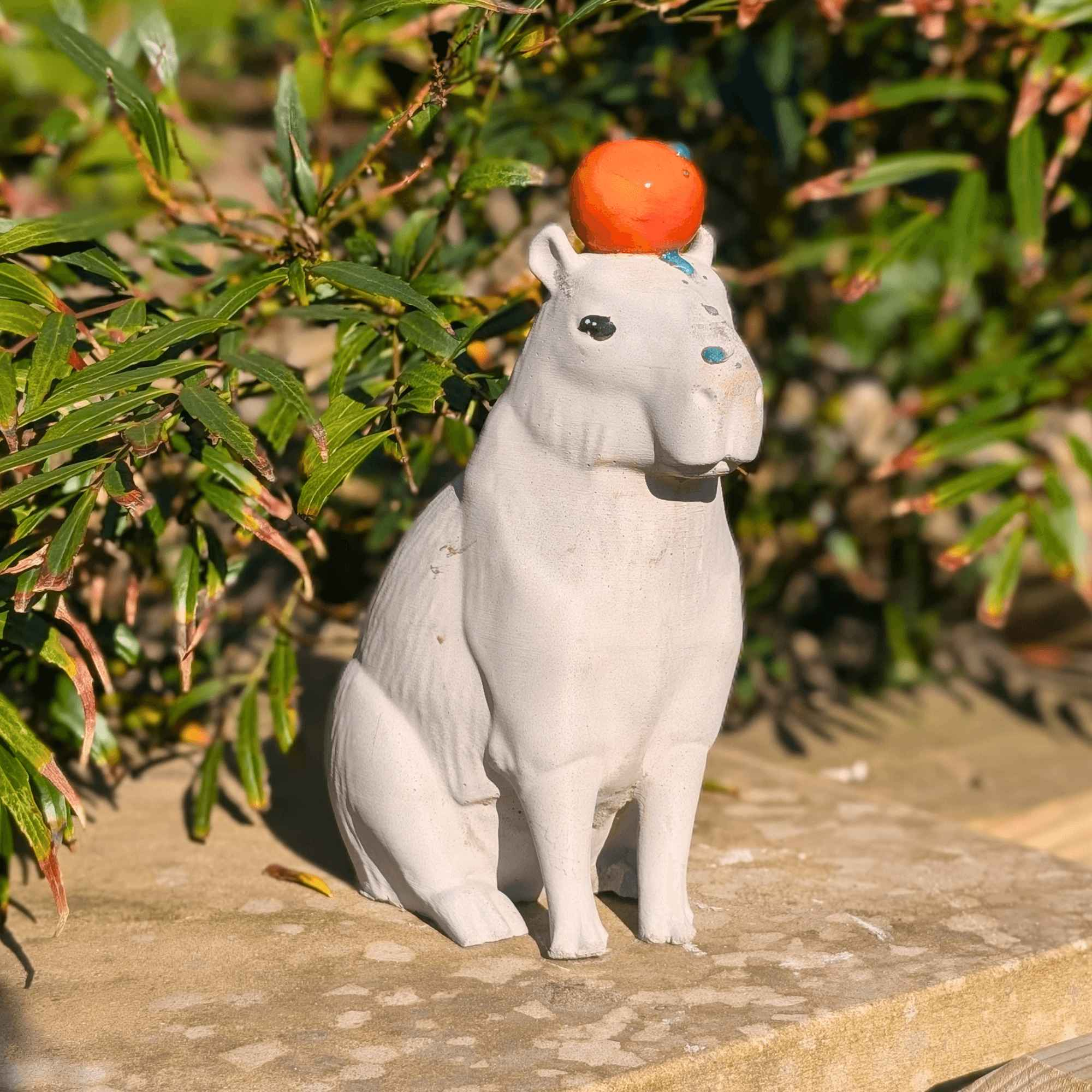
| Small animal figure | Ground cover: Thymus serpyllum (creeping thyme), Soleirolia (mind-your-own-business), Sagina (Irish moss) | Low, tight planting provides a "landscape" around the figure |
Planting distance: In a small bed, plant 10-15cm from the base of the ornament. Close enough to frame it, far enough to allow air circulation around the stone and prevent moisture being held against the surface (which accelerates algae growth).
Seasonal interest: In a small garden, you see the same plants every day. Choose at least one plant per bed that changes through the seasons: spring bulbs (Crocus, Muscari), summer flowers (Lavandula, Salvia), autumn colour (Acer in a pot, Cornus), and winter structure (Helleborus, evergreen ferns).
Cast stone earns its keep most in winter , when plants die back, permanent sculptural elements hold the garden's visual identity through the bare months.
Layout Principles for Compact Spaces
Key takeaway: Small gardens work best with clear zones, diagonal sight lines, and a deliberate limit on the number of materials.
Diagonal sight lines. Place your focal point in the far corner rather than centred on the back wall. The diagonal of a rectangle is longer than either side. This simple trick makes a small garden feel noticeably longer. Draw an imaginary line from your back door to the opposite far corner. That is your longest view.
A cast stone piece placed diagonally across the garden from the main viewing position creates the longest sightline and maximises perceived depth.
Limit materials to three. In a small space, too many materials (timber, stone, brick, gravel, metal, tile) create visual chaos. Choose three: one for surfaces (e.g., paving), one for structure (e.g., timber fencing), and one for ornament (e.g., cast stone). Cohesion makes small spaces feel considered, not cramped.
Use curves. A gently curved path or bed edge in a rectangular garden breaks the corridor effect. Even a slight arc makes the space feel wider. The RHS and Garden Designers' Guild consistently recommend curves in small garden plans.
Leave empty space. This is the hardest rule. Resist the urge to fill every corner. A section of clean paving, a patch of gravel, or an unfilled planter gives the eye rest and the garden breathing room. Empty space is not wasted space. It is design.
Quick Reference: Ornament Sizes for Small Gardens
| Garden Size | Ground Placement | Shelf / Table | Wall / Hanging |
|---|---|---|---|
| Under 10m² | 1 piece, 20-35cm height | 1-2 pieces, 10-20cm | 1 piece |
| 10-20m² | 1-2 pieces, 25-45cm | 2-3 pieces, 10-25cm | 1-2 pieces |
| 20-30m² | 2-3 pieces, 30-60cm | 2-4 pieces, 15-30cm | 1-2 pieces |
The weight test: In a small garden where people walk close to ornaments, stability matters. Choose pieces heavy enough to resist wind and accidental knocks. Cast stone is naturally heavy for its size, which is one of its advantages over resin in outdoor use. Check the weight on the product listing and pair it with a flat, stable surface.
Sources
Professional Organisations and Design References
- RHS. "Small garden design ideas." rhs.org.uk
- RHS. "Chelsea Flower Show: small garden category." rhs.org.uk
- Garden Designers' Guild. "Designing small spaces." gardendesignersguild.org.uk
- ONS. "Housing stock and garden size data." ons.gov.uk
- Rightmove. "Average garden sizes in the UK." rightmove.co.uk
Design Principles
- Brookes, J. John Brookes' Garden Design. DK Publishing, 2001. (Focal point and sight line principles)
- Oudolf, P. & Kingsbury, N. Planting: A New Perspective. Timber Press, 2013. (Plant pairing and contrast)
- Stuart-Smith, S. The Well Gardened Mind. William Collins, 2020. (Psychological impact of garden spaces)
Practical Guides
- Dunnett, N. & Kingsbury, N. Planting Green Roofs and Living Walls. Timber Press, 2008. (Vertical planting)
- RHS. "Lighting your garden." rhs.org.uk
- Which? Gardening. "Solar lights: best buys." which.co.uk
Further Reading
- Gothic garden design 2026: the complete UK planting and styling guide
- How to care for cast stone garden ornaments
- Shop the garden collection
This guide was written by Ripleys Nest based on years of making cast stone ornaments and seeing how customers use them in real UK gardens. Every sizing recommendation comes from practical experience. Last reviewed: March 2026.
Further reading: RHS small garden advice | BBC Gardeners World
GARDEN
Choose the outdoor piece
Use the guide to decide what belongs in the space, then compare cast-stone pieces by size, weight, finish and where they will sit.
New to Ripleys Nest? Join the list for 10% off your first order.

Pieces from this guide
- Professor Grumbletoad Wizard Frog Garden Ornament
- Mushroom Frog Garden Ornament | Mallowcap
- The Little Critic Owl Garden Ornament


